Between the moment your ad appears and the moment the courier leaves with the money, about ten things happen, and you control half of them. This article sets out the seven behaviours that recur among Tunisian buyers, what the available figures say about them, and what each one demands of your store.
In short: your customer arrives from a social feed on a phone, compares quickly, wants a human reply within the hour, reads the delivery line before the price, and makes the decision twice: at the screen, then at the door. A store that ignores the second decision loses money without understanding why.
1. They arrive from a feed, not from a search
Most first visits come from Facebook, Instagram and TikTok, not Google. In practice, your visitor was not looking for your product: they ran into it. They have no prior intent, no patience, and ten other pieces of content a second away.
What that demands: your product page must answer three questions in four seconds, without the customer scrolling. What is it? What does it cost? How do I get it? Everything else comes after.
The audience is there: DataReportal’s Digital 2026 report counts 10.4 million internet users in Tunisia at the end of 2025, 84.3% of the population, and 7.83 million social media accounts in October 2025. Our article on selling through Instagram and Facebook covers the move from private messages to a real store.
2. They buy on a phone, and abandon more on a phone
With 15.5 million active mobile connections at the end of 2025, around 125% of the population, the phone is not one channel among several, it is the channel.
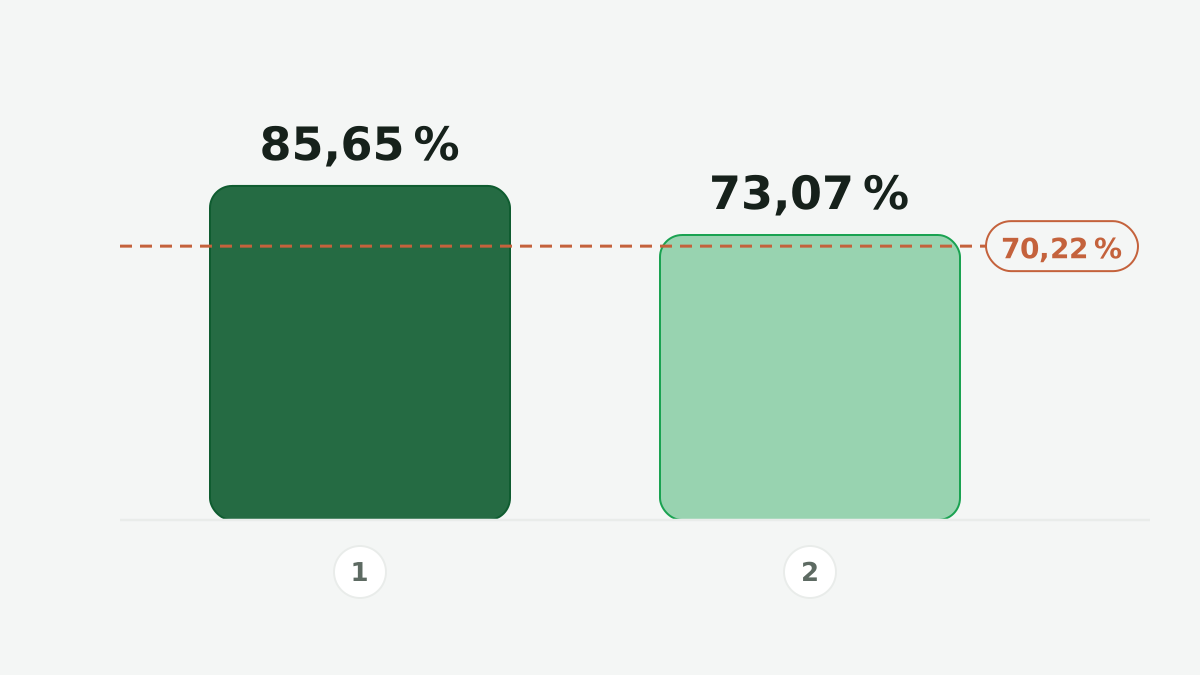
The catch is that mobile is also where people give up most. The Baymard Institute, which aggregates around fifty studies on the subject, measures an average cart abandonment rate of 70.22%, with a clear gap by device.
What that demands: test your store on your own phone, one-handed, on 4G, while walking. If you have to zoom to read the price or aim at a button that is too small, you are losing sales your advertising already paid for.
3. They want to pay when they see the product
Available estimates put cash on delivery at 70% to 80% of online orders in Tunisia, against a world average of around 7%. This is not a vague cultural preference, it is a rational answer to three realities: people have received products that did not match the photo, not everyone has a card that works online, and paying cash at the shop is a lifetime habit.
Online payment is growing: the Central Bank of Tunisia reported a sharp rise in mobile payments in 2025, driven by e-wallets such as D17 and Flouci. But the balance has not tipped.
What that demands: offer cash on delivery first, visible on the product page rather than hidden on the final screen. Add online payment as an option for the minority who prefer it. Carrier rates and payout timings are covered in our cash on delivery guide (in French).
4. They expect a human reply, fast, on WhatsApp
Tunisian customers message before they buy, and they write in dialect, mixing Arabic and French. They ask a question they could have read on the page, because the real question underneath is: “is anyone there?”
A reply within the hour turns hesitation into an order. A reply the next day arrives after they have ordered elsewhere, or just in time for them to refuse the parcel.
What that demands: a WhatsApp number visible on every page, and reply discipline. If you cannot answer in the evening, say so: an honest automatic message beats silence.
5. They read the delivery line before the price
It is counter-intuitive and consistent. Before deciding whether the product is worth its price, the buyer wants to know what they will pay in total, and when it arrives. An attractive price followed by surprise fees at checkout produces exactly the opposite of the intended effect. Baymard’s work puts unexpected costs at the top of the fixable reasons for abandonment, cited by 39% of shoppers who abandon for a specific reason.
What that demands: show the delivery amount and the lead time on the product page. If delivery is free, build it into the price, which means having calculated it properly. Our article on margin and pricing shows how to do that without losing money.
6. They check that you actually exist
This is the most underestimated behaviour. Before giving their address to a stranger, a Tunisian buyer looks for proof: photos that did not come from a catalogue, a phone number that looks real, comments on your page, an address, a written exchange policy.
What that demands, in order of effectiveness:
- Your own photos, taken where you are, with a background recognisable from one product page to the next.
- A Tunisian phone number shown in plain text, not just a contact form.
- An “about” page with a real sentence about who you are and where you are.
- A written exchange and return policy, even short, even strict.
- Customer reviews, including screenshots of WhatsApp messages from happy customers.
7. They decide a second time, in front of the courier
This is the particularity of the Tunisian market, and the one that costs most to those who forget it. The order is not the sale. In between there are several days, some hesitation, sometimes a partner weighing in, sometimes an electricity bill landing.
Available estimates put refused parcels between 20% and 40% depending on the merchant and the category. Every refusal costs a round trip with no revenue against it.
What that demands: confirmation. A message or a call before shipping that restates the product, the exact cash amount to have ready, and the day of delivery. This is not administrative housekeeping, it is the step that decides your profitability, as we show in the article on the three features that matter.
The seven behaviours, and what to change
| The behaviour | What you change this week |
|---|---|
| They arrive from a social feed | The first three seconds of the product page answer what, how much, how |
| They buy on a phone | A full one-handed test on 4G, on your own phone |
| They pay cash on delivery | Cash on delivery visible on the product page |
| They expect a fast reply | WhatsApp number on every page, reply within the hour |
| They look at delivery first | Delivery amount and lead time shown above the order button |
| They check that you exist | Your own photos, a Tunisian number, a written exchange policy |
| They re-decide at the door | Systematic confirmation before shipping |
Where to start if you change only one thing
Take your phone, open your store in a private window, and order your own product from start to finish. Time it. Note every point where you hesitate, where you have to zoom, where information is missing. That list, made honestly, is worth more than any audit.
Then put confirmation before shipping in place if you have not already. It is the only action that simultaneously improves your delivery rate, your advertising cost per sale and your margin.
For the whole picture, the complete guide to ecommerce in Tunisia covers the journey from product to first customer.