The question comes up in every conversation: what does it actually cost. Public answers are rarely complete, because the advertised price is almost never the price paid. Here is the entire budget for a Tunisian online store over twelve months, including the amounts nobody puts on their pricing page.
In short: a serious store on a local platform costs about 850 DT in the first year, advertising excluded. The same store on an international platform approaches 1,500 DT, and on a custom build 2,800 DT. The difference does not come from the quality of the site, it comes from currency, add-ons and maintenance.
The cost lines, one by one
The domain name
About 40 DT a year for a .tn through an accredited registrar. A .com often costs slightly less, but the .tn has two concrete advantages in this market: it reassures Tunisian buyers at the moment they hand over cash, and it helps your visibility on local searches. It is one of the few lines where paying more is justified.
The platform or the site
This is the main line, and the only one that swings from single to fivefold depending on the route you take. We cost the three scenarios below.
Photos
The most underestimated line. You can shoot them yourself with a recent phone, a white sheet and daylight: that is free and often good enough. Budget 100 to 300 DT if you use a photographer for a first set of ten products. Your supplier’s catalogue photos cost nothing and convert like nothing too.
Packaging
Boxes, bubble wrap, tape, labels. Over the first few hundred parcels, budget roughly 2 DT per shipment, so 60 to 120 DT to get going. Decent packaging cuts breakage and returns, and pays for itself quickly.
Advertising
It is not part of the cost of the store, but it is part of the cost of launching. Plan 300 to 900 DT over the first three months, spent in slices of 100 to 150 DT on one product at a time. The purpose is not to sell, it is to find out which of your products deserves stock, as covered in our guide to what to sell online in Tunisia.
Your time
It appears on no invoice and it is the heaviest line of all. Retyping twenty orders a day into a spreadsheet, copying addresses, chasing customers one by one: work out what your hour is worth and multiply. Over a year, this line often exceeds the cost of the platform.
The three costed scenarios
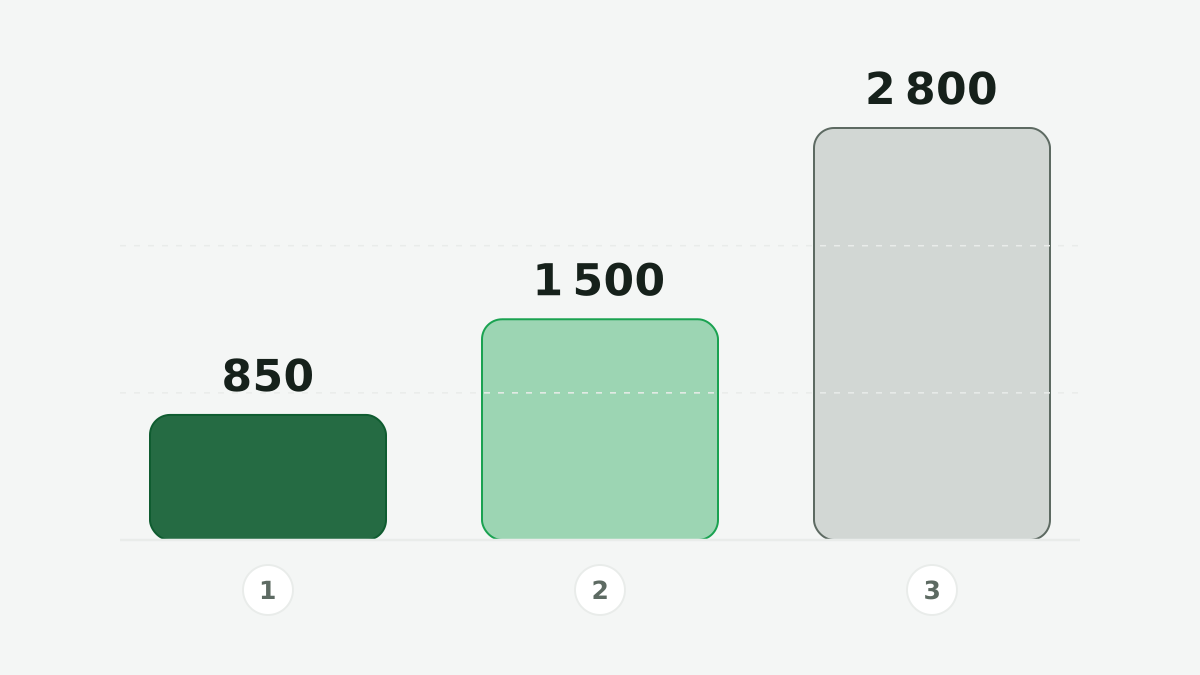
Scenario 1: local platform, about 850 DT
| Line | Amount over 12 months |
|---|---|
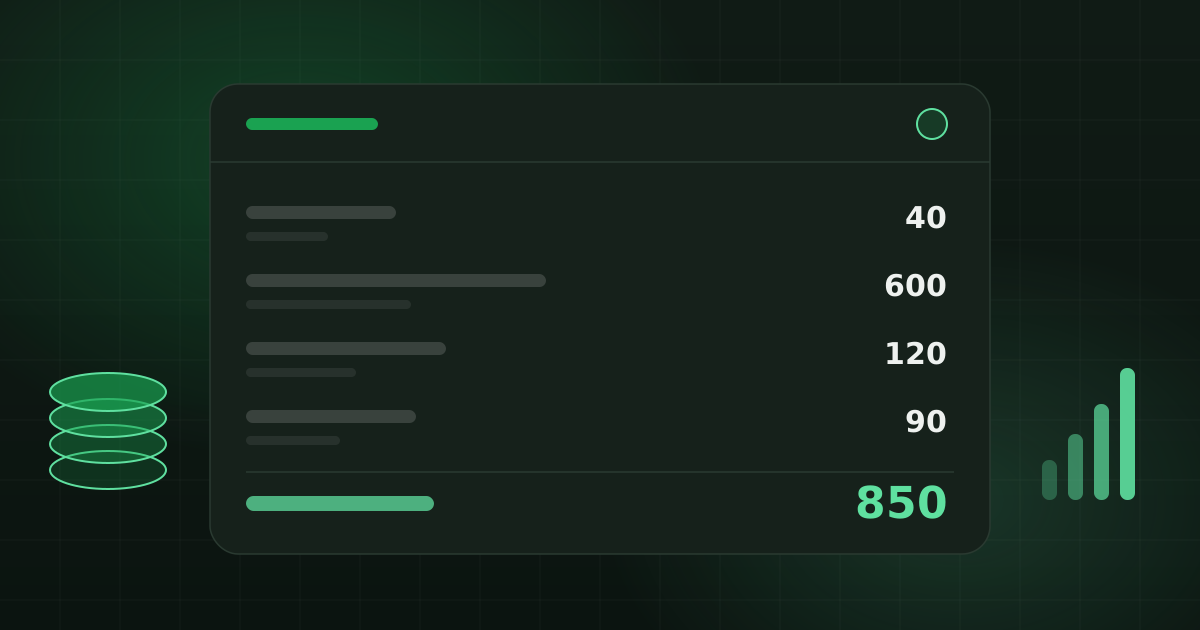
| Platform subscription | 600 DT |
| .tn domain name | 40 DT |
| Starter photos and packaging | 120 DT |
| Incidentals (logo, printing, tests) | 90 DT |
| Total excluding advertising | 850 DT |
Hosting, the security certificate, updates and support are included in the subscription. There is no commission on sales, so the budget does not move as your revenue climbs. This is the most predictable scenario.
Scenario 2: international platform, about 1,500 DT
| Line | Amount over 12 months |
|---|---|
| Entry plan (around 29 USD a month) | ~1,080 DT |
| Domain name | 40 DT |
| Two essential apps | ~360 DT |
| Total excluding advertising | ~1,480 DT |
Two important caveats. First, these amounts are in foreign currency: they move with the exchange rate and assume an international card, which is not a detail in Tunisia. Second, two apps is a floor, not a ceiling. We set out what is missing and why in our article on the limits of Shopify and WooCommerce in Tunisia.
Scenario 3: custom build, about 2,800 DT
| Line | Amount over 12 months |
|---|---|
| Initial development | 1,800 DT |
| Hosting and domain | 400 DT |
| Maintenance and changes | 600 DT |
| Total excluding advertising | 2,800 DT |
The 1,800 DT figure corresponds to an entry-level build. Quotes on the Tunisian market run from 800 DT for a simple showcase to 5,000 DT and beyond for a full site. Watch year two: development does not repeat, but hosting and maintenance do. And every new feature means calling the developer back.
The five costs nobody quotes you
Per-sale commission. This is the core mechanism of plans presented as free. The arithmetic is easy and rarely done: 1% commission on 40,000 DT of annual sales costs 400 DT. At 100,000 DT of sales it is 1,000 DT. A fixed subscription becomes cheaper as soon as you do well, which is precisely when you do not want to be penalised.
Thresholds. “Free up to X dinars of sales” means the pricing changes above that. Look at what it becomes, not what it is today, and run the numbers against your one-year revenue target.
Apps. Every gap in the platform gets filled with a paid extension on a monthly subscription. Four apps at 8 USD a month is over 1,000 DT a year.
Renewals. Many freelance quotes cover the first year of hosting. The second arrives without warning, often alongside the certificate renewal.
Leaving. What happens if you go? Can you export your products, customers and orders? A platform that makes leaving hard has an exit cost, even if it is written nowhere.
The minimum budget to start seriously
If cash is tight, here is the most effective split for a first month at 400 DT:
- Platform subscription, 50 DT (or nothing in month one, on a trial period).
- Domain name, 40 DT. Do not skip it: a store without its own domain inspires less confidence.
- Basic packaging, 60 DT. Enough to ship thirty parcels properly.
- Test stock, 100 DT. Two or three units of each candidate product, bought from a local wholesaler.
- Advertising, 150 DT. On one product, over five days.
Total: 400 DT, of which 250 DT goes directly into learning what sells. That is a testing budget, not a launch budget, and it is exactly what month one needs.
What not to economise on
Three lines where cutting costs more than it saves:
- Photos. A bad photo drags down conversion across every visit you pay for. It is the best return on 200 DT you will find.
- Packaging. A parcel that arrives damaged means a return, a refund and a lost customer, all to save 1 DT of cardboard.
- The domain name. A free subdomain address, in a market where trust is the first obstacle, costs you sales every day.
And after year one?
The budget on a local platform stays flat: 600 DT of subscription, 40 DT of domain, plus packaging in proportion to volume. It is your variable costs that take over, and they are what decide your profitability: delivery, advertising and returned parcels. We work through that calculation in our article on pricing and margin.
For the whole picture, from product choice to first customers, the complete guide to ecommerce in Tunisia covers the full journey.