Shopify and WooCommerce are two excellent products. They are not bad choices in themselves, they are choices built for a different market than yours. This article is not a checkbox comparison: it describes what breaks in the daily reality of a Tunisian merchant selling cash on delivery, and where the real bills show up.
In short: both platforms can display “cash on delivery” at checkout. Neither handles what comes after, which is the part that matters in Tunisia: calling the customer to confirm, handing the parcel to a local courier, tracking cash collection, and counting returned parcels. You will rebuild that flow by hand or buy it in add-ons.
The five stages of a Tunisian order
Before comparing anything, it helps to describe what a real order looks like here:
- The customer orders on mobile, usually after a Facebook or Instagram ad.
- You contact them to confirm, normally on WhatsApp, within the hour if you can.
- You pack the parcel and hand it to Rapid-Poste, Aramex, First Delivery or an independent courier.
- The courier collects cash and the carrier pays you back within 24 to 72 hours, fees deducted.
- A share of parcels comes back. You need to know which ones, and what they cost you.
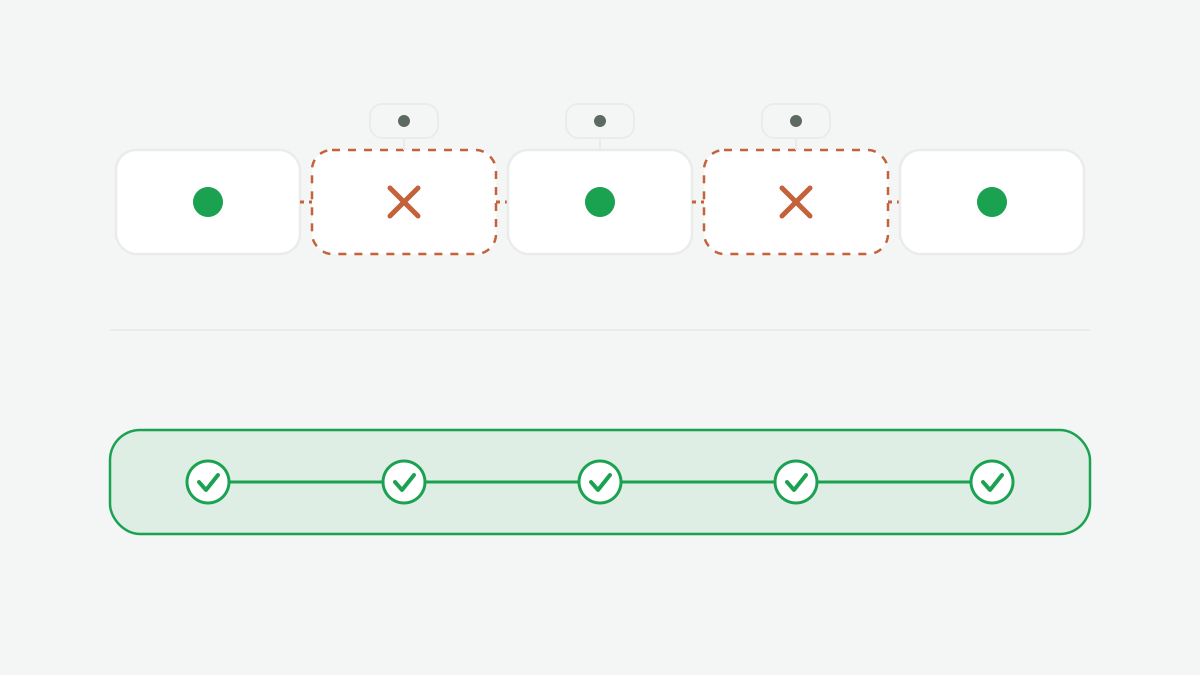
A platform suited to Tunisia covers all five stages. International platforms cover the first, partly the third, and leave you the rest.
What breaks with Shopify
The billing currency
This is the first wall, and nothing about it is technical. The Shopify subscription is billed in foreign currency and charged to an international card. From Tunisia that means a foreign-currency card, an allowance, or an arrangement with a relative abroad. The arrangement holds for a few months. It does not hold once the business grows, paid apps get added, and every charge depends on someone else being available.
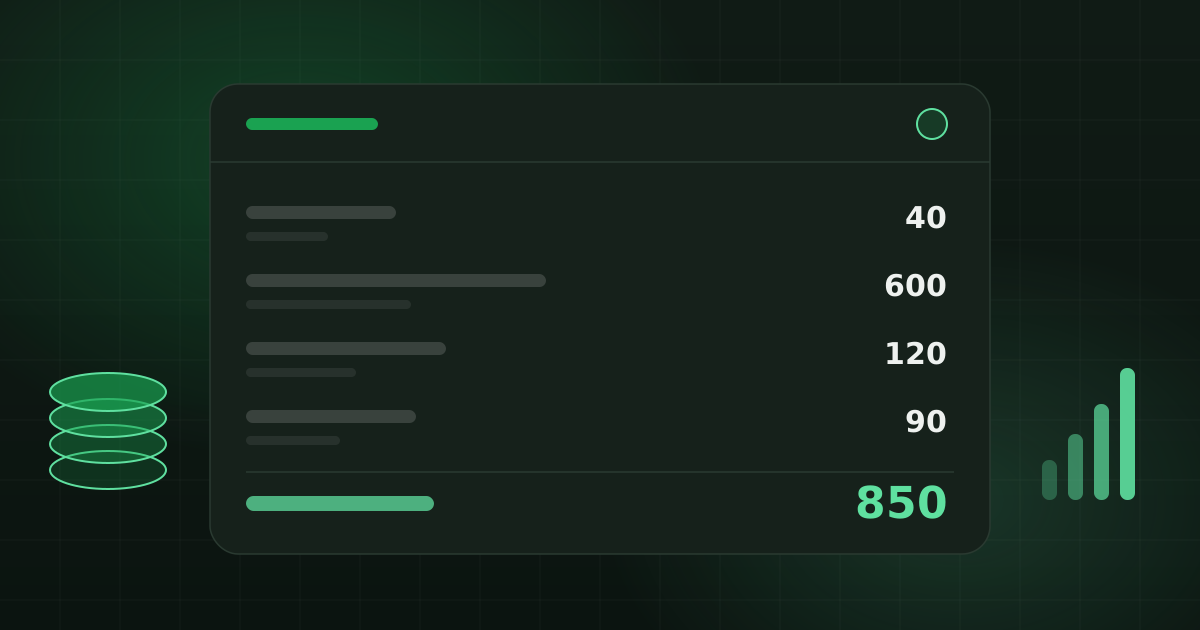
On the entry plan, around 29 USD a month, you are already past 90 DT before a single app, and the amount moves with the exchange rate.
Tunisian couriers
Shopify integrates dozens of carriers. None of them are Tunisian. In practice: no waybill generated automatically, no tracking number pushed back into the order, no “delivered” or “returned” status synced. You copy addresses into the courier’s spreadsheet and update statuses by hand, one order at a time.
The confirmation call
This is the single most profitable step in the Tunisian flow, and it does not exist in Shopify. There is no “awaiting confirmation” status between the order and fulfilment. You add an app, or you keep a separate file, which means leaving the platform to do the most important work of your day.
The app stack
Every gap is filled with an app, and every app has its own monthly subscription, also in foreign currency. A COD-friendly order form, a courier connector, a confirmation module, a dashboard that actually reports delivery: you quickly reach twice the starting price, for a set of parts nobody maintains as a whole. The day one app breaks after an update, you are chasing that vendor’s support, not Shopify’s.
What breaks with WooCommerce
WooCommerce raises different problems. The plugin is free and very flexible. What you pay is time.
- Hosting. A slow WooCommerce is a WooCommerce that does not sell. On a Tunisian mobile connection, a site that takes five seconds to render a product page loses most of its visitors before they reach the price.
- Updates. WordPress, WooCommerce and every extension update separately. An unlucky combination breaks checkout without warning, often on a day you are running ads.
- Security. An unmaintained WordPress is a target. That is not a hypothetical, it is the state of thousands of abandoned sites.
- Dependence on one person. The developer who built the site knows how it works. If they stop answering, the smallest change becomes a project.
For a merchant who already has a technical team or a contracted provider, none of this is blocking. For someone selling clothes in Sousse on their own, it is a second job.
Stage by stage
| Order stage | Shopify | WooCommerce | Local platform |
|---|---|---|---|
| Mobile ordering | Native, very good | Depends on theme and hosting | Native |
| Customer confirmation | Add an app | Add an extension | Built in, pre-filled WhatsApp link |
| Tunisian couriers | None as standard | Third-party extensions, uneven quality | Integrated |
| Cash reconciliation | Outside the platform | Outside the platform | In the dashboard |
| Returned parcels | Tracked manually | Tracked manually | Counted automatically |
| Billing | Foreign currency | Hosting in foreign currency or dinars | In dinars |
| Support | English, time-zone gap | Community or provider | French and Arabic |
When an international platform is still right
It would be dishonest to conclude that Shopify and WooCommerce have no place in Tunisia. Three cases fully justify them:
- You sell for export. If a meaningful share of your revenue comes from Europe or the Gulf and settles by card, the logic reverses: you need international payments, multi-currency and global logistics integrations.
- You have a technical team. With a developer in-house, WooCommerce becomes an asset: you build exactly what you want without asking anyone’s permission.
- You have a genuinely unusual requirement. Complex product configurators, subscriptions, B2B selling with negotiated rates: these fall outside the standard and deserve an extensible platform.
If none of those three describe you, the cost of that power far exceeds what it returns. We worked through the numbers in what an online store really costs in Tunisia.
Switching platforms without losing sales
A botched migration costs more than the platform you are leaving. The method that works has five steps:
- Export first. Products, customers, orders, as CSV. That file is your insurance. If a platform will not let you export, that alone is a reason not to go there.
- Rebuild without cutting over. Set up the new catalogue while the old site is still running. Nobody should see the transition.
- Test five real orders. End to end, with a real parcel, a real courier, and at least one deliberate refusal so you can see how the return is handled.
- Move the domain on a Tuesday morning. Not a Friday evening, not the day before a campaign. You want to be available if something jams.
- Keep redirects. Your old product URLs must redirect to the new ones, or you lose the search rankings you built.
What to take away
The real criterion is not how long the feature list is, it is how many steps of your day the platform handles without you. If you have to reopen a spreadsheet after every order, the most powerful platform in the world is costing you money.
For the wider picture, the complete guide to ecommerce in Tunisia covers the journey from start to finish, and our piece on the three features that actually matter explains what to test before you sign.