Cash on Delivery in Tunisia: Delivery Companies, Fees and Payout Times (Seller Guide 2026)
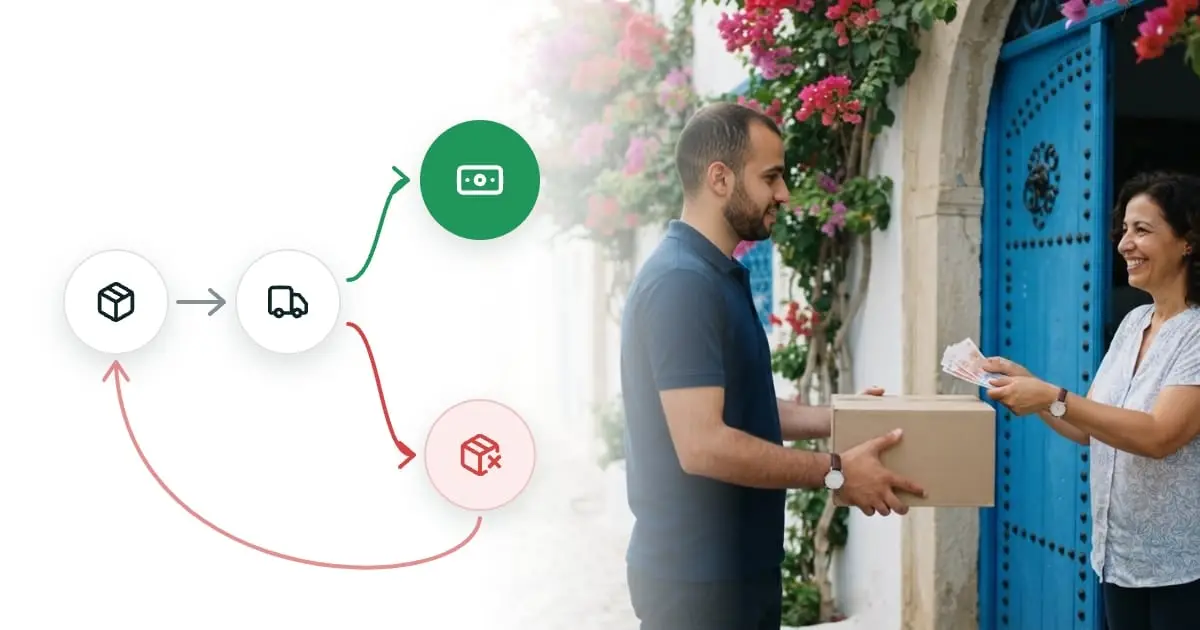
Cash on delivery is the default payment method of Tunisian ecommerce: the customer pays the courier in cash, and the delivery company pays you back minus its fees. For a seller, profit comes down to four numbers: the price per parcel, the cost of a refused parcel, the payout delay and the refusal rate.
In short: only one Tunisian delivery company publishes its full price list (Intigo: 8.000 to 5.600 TND per small parcel depending on volume, payout within 24 to 48 hours). The others work on quotes. Get the price, the return fee and the payout delay in writing, confirm every order before shipping, and know that a 3% withholding applies to the cash collected if you give no tax ID.
How does cash on delivery work, step by step?
An order paid at the door goes through five steps. The times shown are those of a well-run store.
- The customer orders without paying (2 minutes). They give their name, phone and address on your store or by message.
- You confirm the order (5 minutes, ideally within the hour). A call or WhatsApp message checks the address, the size and the intent to buy. This is the step that brings refusals down.
- You hand the parcel to the carrier (same day). Most companies collect from your premises.
- The courier collects the cash (24 to 72 hours depending on the region). The customer can still refuse the parcel at this point.
- The company pays you back (24 to 48 hours after delivery at Intigo, on the agreed schedule elsewhere), minus delivery fees and, where it applies, the withholding.
In a dashboard like Yalla Souk’s, steps 1 to 3 happen without leaving the order: confirmation, one-click handover to a connected carrier, then parcel tracking, with the status refreshed in one click from the order.
Which delivery companies serve ecommerce in Tunisia?
Here are the delivery companies online sellers use most, with what each one publishes on its own site. Checked on 22 October 2026: terms change, so check them before you sign.
| Company | Cash on delivery | Public prices | Stated delay | Pickup at your place |
|---|---|---|---|---|
| Intigo | Yes | Yes, full price list (see below) | Next day in all 24 governorates | Yes, no pickup fee |
| Navex | Yes | No, on quote | 24 h express, nationwide | Yes |
| First Delivery | Payment service advertised, terms on quote | No, on quote | 24 h or same day, 14 branches | Yes, free |
| Best Delivery | To confirm with the quote | No, on quote | 24 h, same day in main cities if picked up before noon | Yes |
| Adex | To confirm with the quote | Stated cap: no more than 8 TND | 24 to 72 h, all of Tunisia | Yes |
Two notes. La Poste (Rapid-Poste) covers the whole country through its offices, but we found no public cash-on-delivery offer for online sellers: ask at a branch. And price alone is not enough: a 7 TND carrier that pays out in ten days and charges 4 TND per return can cost more than an 8 TND one.
Carriers in Yalla Souk: more than 100 Tunisian companies and growing, more than 20 of them connected automatically (Navex, First Delivery, A2B Delivery, Colissimo, Aramex, Intigo…). With those, you hand over the parcel from the order page and follow its status without switching tools; the others are followed by hand (see all integrations). If your carrier is not on the list, ask: we add it.
What does a delivered parcel cost, and a refused one?
Intigo’s price list is the only one published in full. It is a useful reference when negotiating with the others.
| Volume over 30 days | Small parcel (S) | L parcel | XL parcel |
|---|---|---|---|
| 0 to 100 parcels | 8.000 TND | 10.000 TND | 15.000 TND |
| 101 to 500 | 7.500 TND | 10.000 TND | 15.000 TND |
| 501 to 1,500 | 7.000 TND | 10.000 TND | 15.000 TND |
| 1,501 to 5,000 | 6.500 TND | 10.000 TND | 15.000 TND |
| 5,001 to 10,000 | 6.000 TND | 10.000 TND | 15.000 TND |
| Over 10,000 | 5.600 TND | 10.000 TND | 15.000 TND |
Source: intigo.net, checked on 22 October 2026. The site does not say whether these prices include VAT: ask.
The cost of a refused parcel is the other line that matters. At Intigo it depends on your own return rate for a small parcel:
| Your return rate | Fee per return (S parcel) |
|---|---|
| Under 10% | 0 TND |
| 10 to 15% | 1 TND |
| 15 to 20% | 2 TND |
| 20 to 25% | 3 TND |
| Over 25% | 4 TND |
L and XL returns cost 4 TND. The logic is sound: a seller who confirms orders well pays less for each refusal. But the real cost of a refusal is not just this fee: the ad spend that brought in the order is lost too. To work out the full picture with your own figures, use our free margin calculator, which spreads ads and refusals over the orders actually delivered.
What should you ask a delivery company before signing?
Ask for written answers to these eight questions. A serious company answers within a day.
- Price per parcel at your volume, with or without VAT, and at what volume it drops.
- Fee for a refused or returned parcel, and whether it depends on your return rate.
- Cash collection fee: some companies charge for collecting the cash separately.
- Payout delay: 24 hours, once a week, on request?
- Payout method: bank transfer, D17, cash at a branch.
- Coverage and delays in your governorates, not only Greater Tunis.
- Pickup at your place, hours and any cost.
- Integration with your store (automatic parcel creation, synced tracking) and the procedure for a lost or damaged parcel.
The right move: test two companies side by side for a month on comparable orders, then keep the one that delivers the most parcels at the lowest total cost, not the one with the lowest unit price.
How many parcels are refused, and how do you lose fewer?
Public figures are rare. The most quoted estimate, from Tayara.tn as reported by Tunisie Numérique in 2025, puts refusals at about 30% of parcels. The rate varies enormously between sellers: it depends mostly on what happens between the order and the shipment.
| Lever | Expected effect |
|---|---|
| Confirm every order within the hour | Filters out impulse orders and address mistakes |
| Give a precise window (“tomorrow before 2 pm”) | The customer stays reachable and available |
| Real photos, exact size and material | Fewer “not what I saw” refusals |
| Delivery fees shown on the product page | No surprise at payment time |
| Check a customer’s history | Spots numbers that often refuse |
| Remind the customer before the courier arrives | They have the cash ready |
On a product sold for 89 TND with 18 TND of ads per order, going from 30% to 20% refusals adds several dinars of margin per delivered order: ads and returns are spread over more successful deliveries. The full calculation is in our guide on how to calculate ecommerce margin in Tunisia.
In Yalla Souk, every order goes through a confirmation step (call attempts, callback, refusal with a reason), a customer reliability card draws on refusals reported by sellers, and anti-fraud rules can block or hold suspicious orders before they cost a round trip.
What is the 3% withholding on collected cash?
This is the rule many sellers discover on their first statement. Since 1 January 2025 (2025 Finance Law, Law No. 2024-48 of 9 December 2024, explained by general note No. 6 of 2025), delivery companies, La Poste included, withhold 3% of the cash they collect for a seller who does not give them a tax ID, whatever the amount.
| Seller’s situation | Withholding on cash collected |
|---|---|
| No tax ID given | 3%, from the first dinar |
| Tax ID given | Reduced rates (1.5%, 1% or 0.5% depending on the case), above 1,000 TND |
The withholding is an advance on your tax, not a final tax: it is deducted from the tax you owe if you are registered. It is a concrete reason to put your status in order, which we explain in the guide to selling online legally in Tunisia (auto-entrepreneur, RNE, tax ID).
Should you offer online payment too?
Yes, as an extra. Online card payments reached 1.375 billion dinars in 2025, up about 31% according to the Central Bank of Tunisia, and mobile payments are growing faster still. But only 8.7% of Tunisians buy online according to CONECT (June 2026), and most of them expect to pay at the door.
The right setup in 2026: cash on delivery by default, card payment (Flouci, for example) offered as an option, possibly with a small perk for those who pay upfront. A parcel paid online is almost never refused.
Where to start?
- Create your store on a platform that handles cash on delivery and order confirmation natively. Our guide to ecommerce in Tunisia covers the options.
- Ask three delivery companies for a quote using the eight questions above.
- Set your price with delivery, ads and refusals built in, using the margin calculator.
- Confirm every order before shipping, without exception.
- Track three numbers every month: refusal rate, average payout delay, margin per delivered order.
To compare the platforms themselves, see our comparison of ecommerce platforms in Tunisia.
Frequently asked questions
How does cash on delivery work for a seller in Tunisia?
The customer orders without paying, you confirm the order by phone or WhatsApp, you hand the parcel to a delivery company, the courier collects the amount in cash, then the company pays you back minus its fees, usually by bank transfer. At Intigo, the only carrier that publishes its terms, payout comes 24 to 48 hours after delivery.
How much does it cost to deliver a parcel in Tunisia?
The only public price list, Intigo's, runs from 8.000 TND for a small parcel (under 100 parcels a month) down to 5.600 TND above 10,000 parcels a month, with 10 TND for an L parcel and 15 TND for an XL. Adex states its price does not exceed 8 dinars. Navex, First Delivery and Best Delivery work on quotes: use those two references to negotiate and get the price in writing.
Which delivery company should I choose to sell online in Tunisia?
Choose on five written criteria: price per parcel at your volume, the fee for a refused parcel, how fast and how the cash is paid back, coverage of the 24 governorates, and integration with your store. Ask two or three companies for a quote and test two side by side for a month before committing.
How many cash-on-delivery parcels are refused?
Published estimates sit around 30% of parcels refused at delivery (a Tayara.tn estimate reported by Tunisie Numérique in 2025). The rate varies widely by product, region and above all confirmation: a seller who confirms every order before shipping gets well below it.
What is the 3% withholding on cash on delivery?
Since 1 January 2025 (2025 Finance Law), delivery companies withhold 3% of the cash they collect for a seller who does not give them a tax ID (matricule fiscal), whatever the amount. A seller with a tax ID falls under reduced rates (1.5%, 1% or 0.5%) above 1,000 TND. The withholding is an advance on tax, not a final tax.
How do I reduce refused parcels?
Confirm every order by phone or WhatsApp before shipping, ideally within the hour, give a precise delivery window, describe the product faithfully (size, material, real photos), show delivery fees on the product page, and check the customer's history when you can. Every point of refusals you remove raises your margin per delivered order.
Should I offer online payment as well as cash on delivery?
Yes, as an option. Card payment is growing fast (1.375 billion dinars of online payments in 2025, about +31% according to the Central Bank of Tunisia), but cash on delivery is still what most buyers expect. Offer both, with cash on delivery as the default.